Be yourself; Everyone else is already taken.
— Oscar Wilde.
This is the first post on my new blog. I’m just getting this new blog going, so stay tuned for more. Subscribe below to get notified when I post new updates.
Be yourself; Everyone else is already taken.
— Oscar Wilde.
This is the first post on my new blog. I’m just getting this new blog going, so stay tuned for more. Subscribe below to get notified when I post new updates.

Bibliographic information
Montgomery, S. (2008). Quest for the Tree Kangaroo. Boston, Houghton Mifflin.
Genre: Non-Fiction
Suggested Grade Level: 6-8
Response to the book:
This is an AMAZING book that takes you to places you have never even heard of in Papua, New Guinea. I was impressed at the lengths that scientists go to follow their passion and learn more about what they are researching. This is a book that will inspire many students to dream, work hard and achieve their dreams. The details of the cloud forest were brought to life with the intricate descriptions and beautiful photography. This was not a boring science book, but a bridge to a place that has been left alone by the greedy hands of human explorers.
This book is an informational narrative of a scientist whose passion is learning more about tree kangaroos. They are a mammal that resides in a cloud forest of Papua, New Guinea. The narrative clearly describes the lengths that must be taken in order to learn more about this endangered animal. The researchers spend time with the villagers and observe cultural customs. The trek is long and perilous, steep hikes and slippery slopes abound. The task of searching and finding Matschies is arduous, they are one of the world’s rarest and most elusive animals. Locals join the researchers on the mission to find this magical animal. Once tree kangaroos are found they are medically checked, microchipped and have a collar placed that falls off after 5 months, so that the researchers can document their movement and habits.
Lesson Plan:
After reading the book, “Quest for the Tree Kangaroo”, the students will be able to write an essay about one of the animals found in Papua. New Guinea with minimal guidance from teacher.
Lesson Ideas:
Students will illustrate one of the animals described in the story.
Students will write about an animal they would be interested in observing and research where they can do this.
Students will visit the zoo to observe and document behavior and habitat of their favorite animal.
Discussion questions:
What animal would you like to learn more about? Where/how can you do this?
What are you passionate about?
Outside Resources:
https://www.calacademy.org/learn-explore/scientific-expeditions/papua-new-guinea
Bibliographic information
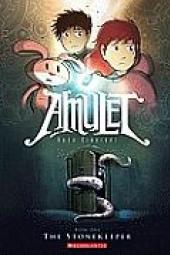
Kibuishi, K. (2008). Amulet – The Stone Keeper. New York, Graphix.
Genre: Graphic Novel
Suggested Grade Level: 3-8
Response to the book:
This book was fun and quick to read. It is fast paced and keeps the reader on edge as you try to figure out what the strange beings and voices are. Mystery, suspense and drama are very prevalent in this book. The death of a parent is a difficult subject to deal with but this book does a great job of displaying the emotions and life altering decisions that must be made in these situations. The fantastic adventure the children must join on their first night at their new house is exciting. Delving into new worlds and seeing new beings will keep the reader turning pages.
This book relates the life of a family whose father died in a tragic car accident. Due to the loss of income, the mother must take the children to live in a home that is owned by her family in a distant village. While everyone is dealing with the change and loss in their own way, Emily and Navin find their great grandfather’s library which contains a special amulet and other creatures from a different realm. The mother is eaten by a strange creature so Emily and Navin listen to the amulet she is wearing and go on a quest to find their great grandfather Silas. They travel to a different realm, meet their dying great grandfather and search for their mother along with Sila’s companions.
Lesson Plan:
After reading the book, “The Amulet”, the students will be able to write or illustrate how they would show the following concepts in a comic (no words): a bad smell, a phone ringing, thinking, shouting, heat with minimal teacher guidance.
Lesson Ideas:
Students will write or illustrate how they would show the following concepts in a comic (no words): a bad smell, a phone ringing, thinking, shouting, heat.
Students will write about a special power they would love to have and draw a picture of what it would look like when they are using the power.
Students will design and create their own amulet.
Discussion questions:
What special power would you like to possess? Why?
When did you figure out the book was a fantasy? Why?
Outside Resources:
http://www.scholastic.com/graphix_teacher/pdf/Scholastic_GrphxWebCast_KKibuishi.pdf
Bibliographic information
Chbosky, S. (1999). The Perks of Being a Wallflower. New York, Pocket Books.
Genre: Young Adult
Suggested Grade Level: 9-12
Response to the book:
Being a mother of two teenage girls, this book was a little difficult for my heart to read. I have a daughter that deals with anxiety and depression, so Charlie’s letters made me anxious. I was grateful that he uncovered why he was anxious and depressed. It broke my heart to find out that the person he loved most in his life was the one who broke him. The entire book I was waiting for him to send a suicide note. Charlie always seemed to be in a hurry to let you know what happened, so I felt like I was listening to my nephew, who has Asperger’s Syndrome. He was innocent and wanted desperately to have friends and belong in the world. It is a book that is very honest and extremely well written from the perspective of a shy teen.
This book is set in Pittsburg, Pensylvania in the 1990’s. It is the story of Charlie who is writing letters to you, the reader. He is the youngest of three children in a traditional family. In his letters you can hear the symptoms of anxiety and depression. In eighth grade, he is devastated by the suicide of his friend, Michael. He struggles his first weeks of high school until he meets Patrick and Sam, two siblings that are not afraid of his quirkiness and that help him steer through some of the difficulties of being a teen. They expose him to typical teen behaviors like drinking, drugs and sex. They also help him navigate through those experiences. These experiences help him to figure out why he has mental issues; his aunt, who he loved and adored, molested him. This is also a book of survival because he lets the readers know he got help and is ok and that there are many people struggling with mantal issues that are surviving everyday!
Lesson Plan:
After reading the book, “The Perks of Being a Wallflower”, the students will be able to create a playlist to recreate a special time in their life independently.
Lesson Ideas:
Students will create a “mixed tape” or playlist to recreate a special time in their life. They will then write what the songs mean and why they were selected.
Students will keep a journal for a month and discuss what it was like to reflect and write about their daily lives.
Discussion questions:
Who did you identify with most in the book? Why?
Why is it important to have a support system?
Outside Resources:
https://selfdiscoveryinart.weebly.com/daily-lesson-plans.html
https://www.gradesaver.com/the-perks-of-being-a-wallflower/lesson-plan/1/classroom-activities

Bibliographic information
Paterson, K. (1977). Bridge to Terabithia. New York, Harper Collins.
Genre: Realistic Fiction
Suggested Grade Level: 5-8
Response to the book:
This book was extremely enjoyable to read. I was drawn into the complicated lives of young children in 5th grade. The worries of being known as the fastest runner, who is talking about whom and gender roles are clearly expressed in this book. It was difficult for me to understand why anyone would want to ban this book. Death is a part of life. Accidental death of a young child is hard to process but no one is eternal. Hiding things doesn’t change how life twists and turns. Jess’s father being hard on him and being bothered by his creativity did lead me to think the father was afraid Jess was to femine because he is in a house with only his father and five females. It did make me reflect on how we place gender appropriate labels on most things we do and are afraid to break away from the mold.
This book is set in rural Virginia in the late 1970s. It is a small town where families still farm to help provide food. Jess’s family has a cow that he tends to, that cow was his closest friend until Leslie moves next door. Leslie is a free-spirited girl who has no boundaries of her imagination. She is not afraid to push the bar on gender activities and becomes the fastest fifth grader in school. She and Jess become very close and create a magical land called Terabithia, where all worries could be put aside and imagination was the limit. Jess is the happiest he has ever been until he finds out his best friend died on the way to Terabithia. The reactions are palpable, his father shows concern and kindness, all but one of his sisters show sympathy and he learns the beauty of sharing Terabithia with the future generation.
Lesson Plan:
After reading the book, “Bridge to Terabithia”, the students will be able to create realistic responses to Leslie’s death for three different characters in the book independently.
Lesson Ideas:
Students will create a journal for three different characters in Bridge to Terabithia. Students will then perform a monologue of their favorite reaction before the class.
Students will create a drawing of what losing a loved one looks like.
Discussion questions:
How would you react in a situation similar to what Jess experienced?
How would you keep Leslie’s memory alive?
Outside Resources:https://study.com/academy/lesson/bridge-to-terabithia-summary-themes.html

Bibliographic information
Park, L. (2002). When my name was keoko. New York, Clarion Books.
Genre: Historical Fiction
Suggested Grade Level: 6-8
Response to the book:
I was uncertain when I first read the book. It took me a couple of chapters to go with the flow of the narrators changing every chapter, they alternated between Sun-hee and Tae-yul. Once I grew accustomed to the pattern, I thoroughly enjoyed the book. It was informative for me because I had forgotten about Korea being under Japan’s rule for so many years and that the defeat of Japan in World War II gave Korea freedom to be an independent country. The current issue of North and South Korea is loosely mentioned in this book. I feel content with having read this book that demonstrates the difference of cultures between Japan and Korea and especially a difference between those cultures and my own as a Mexican/Cuban woman.
This book is set in Korea at the time of World War II. It depicts the life of a typical Korean family during a time when Japan occupied Korea. The anger of not being able to follow Korean traditions and having everything that represented your culture removed or replaced is conveyed very well in this book. The reader is taken on a journey through the perspective of Sun-hee, a young Korean girl and Tae-yul, her older brother. The traditional roles of male and female are described in a manner that is respectful of the Korean culture. Heroism is a strong theme in this book, both in a blatant way and in subtle ways. Uncle defends without remorse and becomes a part of the resistance. The elderly neighbor and Abuji defend Korea in ways that are not brazen but require great valor. The devastating effects of war, hunger, poverty, hatred, loss are all present in this book.
Lesson Plan:
After reading the book, “When my Name was Keoko”, the students will be able to compare and contrast the lives of individuals that live in a country controlled by another country and the lives of undocumented individuals in foreign countries by clearly defining three similarities and three differences independently.
Lesson Ideas:
Students will be able to describe life in Korea while under Japanese control and lives of Mexican, Central American, Afghanistan, Albanian, etc. that are living as refugees or undocumented individuals in a foreign land.
Students can create a poster or drawing depicting similarities and differences between life in Korea while under Japanese control and lives of Mexican, Central American, Afghanistan, Albanian, etc. that are living as refugees or undocumented individuals in a foreign land.
Discussion questions:
How would you react in a situation similar to what Sun-hee and Tae-yul experienced?
How far would you go to defend your nation/family?
Outside Resources:

Bibliographic information
Burton, V. (1942). The little house. Boston, Houghton Mifflin Company.
Genre: Juvenile Fiction
Suggested Grade Level: PreK – 2
Response to the book:
This book open the eyes of the reader to the changes this world has gone through since the industrial revolution. I brings to light all the different pollutions that surround us in the world today. It is amazing to me that it was written in 1942, a time that I feel was less overcrowded and polluted than today. I wondered what Virginia Lee Burton would think of our cities today. The beauty of nature in its simplest forms is a gift that many of us ignore because of the constant need to go!
The plot for this book is what a little house built in the early 1900s goes through when she sees her countryside become a city. The house was to never be sold for money but it was to be built strong and sturdy so that generations of the owner’s family could enjoy it. The house is happy about her location and loves being surrounded by trees and farmlands. She always wondered about what a city was like. As time went by, the little country house was surrounded by everything a city has, tall buildings, traffic, overcrowding and pollution of all sorts. The original owner’s plan becomes reality when his great granddaughter sees the house in the middle of the city and falls in love with it. She moves the house to the country and placed it on land that was reminiscent of the house’s original location.
Lesson Plan:
After reading the book, “The Little House”, the students will be able to compare and contrast the details of the countryside and the city by drawing different images independently.
Lesson Ideas:
Students will be able to draw pictures of the countryside and the city in order to compare and contrast, the two different settings.
Students can build a house using popsicle sticks, glue and markers. They will also create a background of a location they would love to live in and explain it to the class.
Discussion questions:
Where would you like to live and why?
What would your dream location look like?
Outside Resources:
Bibliographic Information
Lowry, L. ( 1993). The giver. Boston, Massachusetts :Houghton Mifflin,
Genre: Young Adult
Suggested Grade Level: 4-8
Response to the book:
I love dystopian novels! I have read the series for “The Hunger Games”, “Divergent”, and “Matched” to name a few. I had not heard of this book and am glad we read it. It is eye-opening to see what society is capable of doing when they want everyone to be the same. Erasing the past is a horrible thing to do; we must be able to learn from our mistakes and make life all our own. Having a life where everything is planned out and mistakes are “released” is terrifying. A beauty of life is learning from our mistakes.
This book is set in the future, where society is completely preselected in every aspect of life. Children are genetically created, the majority of people have the same look, everyone shares the same birthday as anyone else born the same year. Every citizen has the same items in their homes and have the same amount of children. Choices are unheard of in this life, jobs are even chosen for you at the age of 12. Anyone that is not a follower of the rules or is an individual is “released”.
Lesson Plan Idea
After reading the book, “The Giver”, students will be able to create a final chapter for the book that expresses what they think happened to Jonas, Gabriel and his community after he left, independently.
This lesson plan is for children in 8th grade. Before the book is read, all students will make a list of the memories that are the most vivid in their life. They must sort the memories in the categories of positivity and negativity. Students would choose to erase the memories that are painful. Once the book is read, students will revisit the list and see if they have a change of heart.
Have students create a final chapter for the book.
Discussion Questions:
How would your life be different if everything was preselected for you?
What would be easier and what would be more difficult?
Outside Resources:
https://www.walden.com/blog/the-giver-7-creative-classroom-activities/
https://prestoplans.com/2017/01/13/giver-creative-class-activities/
http://www.bookrags.com/lessonplan/thegiver/funactivities.html?gclid=EAIaIQobChMIzIqcjKaR5wIVvxitBh33ZwLhEAMYAyAAEgKTIvD_BwE#gsc.tab=0
This is an example post, originally published as part of Blogging University. Enroll in one of our ten programs, and start your blog right.
You’re going to publish a post today. Don’t worry about how your blog looks. Don’t worry if you haven’t given it a name yet, or you’re feeling overwhelmed. Just click the “New Post” button, and tell us why you’re here.
Why do this?
The post can be short or long, a personal intro to your life or a bloggy mission statement, a manifesto for the future or a simple outline of your the types of things you hope to publish.
To help you get started, here are a few questions:
You’re not locked into any of this; one of the wonderful things about blogs is how they constantly evolve as we learn, grow, and interact with one another — but it’s good to know where and why you started, and articulating your goals may just give you a few other post ideas.
Can’t think how to get started? Just write the first thing that pops into your head. Anne Lamott, author of a book on writing we love, says that you need to give yourself permission to write a “crappy first draft”. Anne makes a great point — just start writing, and worry about editing it later.
When you’re ready to publish, give your post three to five tags that describe your blog’s focus — writing, photography, fiction, parenting, food, cars, movies, sports, whatever. These tags will help others who care about your topics find you in the Reader. Make sure one of the tags is “zerotohero,” so other new bloggers can find you, too.

 Children's Literature Blog